


Atlanta californiensis
Roger R. Seapy
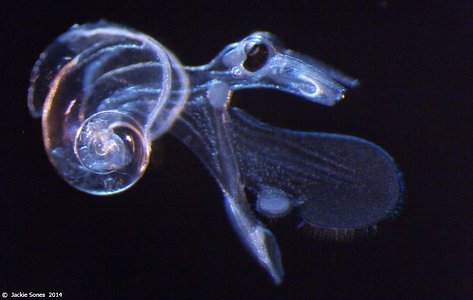
Introduction
Atlanta californiensis is a moderately small species (shell diameter to 3.5 mm), with a transparent, flattened shell. The spire shape is low conical to globular, consisting of about 3-1/4 whorls, and with clear to light violet or purple sutures. Internal walls of spire partially decalcified. The keel base is orange-brown to red-brown. Eyes type a, operculum type c (monogyre), and radula type I, with sexual dimorphism in maximal width, growth angle, number of tooth rows, and tooth shapes and sizes. In California Current waters, A. californiensis is by far the most abundant (if not the only) species in the genus recorded from plankton tows. The geographic distribution of the species is unique among atlantids; it is limited to the Transition Zone faunal province of the North Pacific Ocean.
Diagnosis
A species of Atlanta, belonging to the Atlanta inflata species group, with the following characteristics:
- Shell size moderately small (to 3.5 mm shell diameter), with a laterally-flattened, transparent shell
- Spire shape low conical to globular
- Spire consists of about 3-1/4 whorls and is smooth, lacking surface sculpture
- Spire suture coloration ranges from clear to light violet or purple
- Internal walls of spire partially decalcified
- Keel penetrates between last two shell whorls in shells larger than about 2 mm
- Keel base orange-brown to red-brown
- Eyes type a
- Operculum type c (monogyre)
- Radula type I, radular size, shape, number of tooth rows, and tooth shapes and sizes sexually dimorphic
- Geographic distribution restricted to the Transition Zone faunal province of North Pacific Ocean
Characteristics
- Shell
- Shell of moderate size; maximal diameter about 3.5 mm
- Shell flattened and transparent, except keel base that is orange-brown to red-brown
- Keel penetrates between last and penultimate whorls in shells larger than about 2 mm diameter
- Spire composed of about 3-1/4 whorls
- Spire shape low conical to globular, with a smooth surface (lacking sculpture)
- Spire sutures range in coloration from clear to light violet to purple
- Spire coloration (attributable to underlying tissues) variable; either (a) clear to uniform light yellow, brown, or violet, or (b) mottled light to dark yellow-brown to brown
- Umbilicus deep and wide
Click on an image to view larger version & data in a new window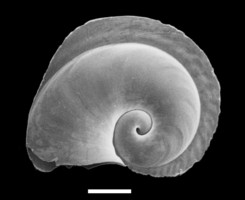
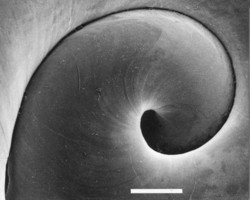
- Internal walls of shell spire partially decalcified and replaced with thin, chitinous membrane
- Eyes type a
- Operculum type c (monogyre)
- Thin, transparent and oval in shape
- Gyre region of operculum lacks spines
Click on an image to view larger version & data in a new window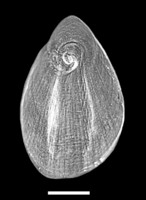 aaa
aaa
Figure. Type c (monogyre) operculum of Atlanta californiensis. Scale bar = 0.25 mm. ©
- Radula type I
- Radula large relative to size of the animal; to a length of 1.0 mm
- Radular elongate and narrowly triangular
- Radular shape and tooth morphologies sexually dimorphic. Male radulae broader, with a wider growth angle, and greater number of tooth rows than in females. Basal plates of central and lateral teeth in females narrower, but higher, and marginal and lateral teeth shorter than in males. (see SEM photographs below) For a detailed comparison of the radular and tooth dimensions of males and females from animals of 1.7-1.8 mm, see Seapy and Richter (1993, pp. 391-392)
Click on an image to view larger version & data in a new windowClick on an image to view larger version & data in a new windowClick on an image to view larger version & data in a new window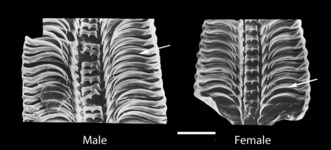
Figure. Radulae of Atlanta californiensis from male (left) and female (right) specimens. Arrows indicate row 60 on each radula. Modified from Seapy and Richter (1993, figs. 8a,b). Scale bar = 50 um. © G. Richter
- Veliger larvae
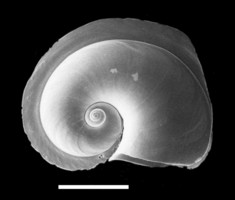
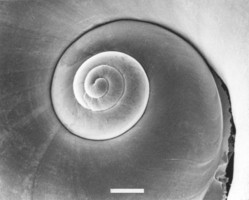
Figure. Shell of 2.5 mm Atlanta californiensis; views of right side of shell (left) and spire (right). Scale bars = 1.0 mm (left) and 0.1 mm (right). ©
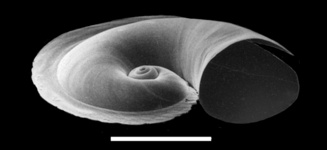
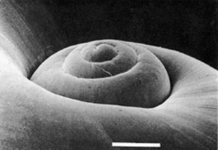
Figure. Shell of Atlanta californiensis, views of right side of shell (left) and spire (right). Scale bars = 1.0 mm (left) and 0.1 mm (right). ©
Figure. Shell of Atlanta californiensis, views of left side of shell (left) and umbilical region (). Scale bars = 0.5 mm (left) and 0.1 mm (right). ©
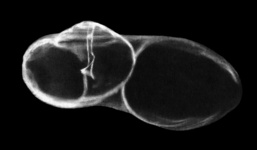
Figure. Shell of Atlanta californiensis, immature specimen in apertural view, illustrating internal whorl decalcification. Dark field transmitted light photograph. © G. Richter.
The larvae of Atlanta californiensis pass through the three distinct stages of development seen in all heteropods (see Pterotracheoidea). Photographs of the second and third larval stages are included below. Note that at stage II the first of the third pair of lobes is beginning to form off the right anterior lobe, while at stage III all three pairs are present
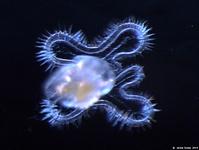
Fig. Late stage II larva of Atlanta californiensis in ventral view. Note the prominent ciliary rows on the velar lobes. © 2015 Jacqueline Sones
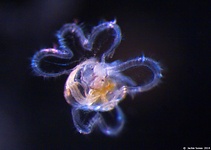
Fig. Stage III veliger larva of Atlanta californiensis in dorsal view with three pairs of velar lobes. © 2015
Morphological features of the body (with type a eyes, type c operculum and type I radula) and shell interior (with partial decalcification of the inner walls of the shell spire and replacement by a thin, flexible chitinous membrane) ally Atlanta californiensis most closely with A. inflata and A. selvagensis. While the shell of A. californiensis is larger (to 3.5 mm), laterally flattened, and has a spire consisting of 3-1/4 whorls, the shells of the other two species are "inflated", with variable development of elevated spiral ridges on the spire (see the A. inflata and A. selvagensis pages). The number of whorls comprising the shell spires are the same in A. californiensis and A. selvagensis, but differ between A. californiensis and A. inflata (with 4-1/2 whorls in the latter species). Also, the shell spire of A. californiensis has a smooth surface, as seen in the shells of A. gaudichaudi and A. peronii. Lastly, the radulae of A. californiensis and A. selvagensis (= A. inflata of Richter, 1987, and Seapy and Richter, 1993) differ; in the former species the radula is broader and consists of fewer tooth rows (Seapy and Richter, 1993).
Distribution
Vertical distribution
The vertical distribution of Atlanta californiensis during daytime hours was studied in waters overlying the San Pedro Basin in southern California (Seapy, unpublished; cited in Seapy and Richter, 1993). Specimens were collected using opening-closing BONGO plankton net tows. The daytime vertical range was found to extend from the surface to about 150 m (the compressed depth range of the epipelagic zone in nearshore basins off southern California). Comparable discreet depth interval samples were not collected at night, so it is not known if this species undergoes nocturnal vertical migration. Such a migration probably does occur, however, since a number of other species of atlantids whose ranges extend throughout the much deeper 0-400m epipelagic zone in Hawaiian waters were shown to be vertical migrators (Seapy, 1990).
Seasonal abundance patterns
Replicated, monthly oblique tows were taken through the epipelagic zone in San Pedro Basin by Cummings and Seapy (2003). Atlanta californiensis was found to occur in low abundances (less than 25 individuals per 1,000 m3) throughout the year except in the summer (to 88 per 1,000 m3 in August). The summer abundance maximum is correlated with the period of the year when California Current flow is strongest and shoreward transport of animals from offshore waters would be predicted.
Geographic distribution
Among the heteropods two species, Atlanta californiensis and Carinaria japonica, are members of the Transition Zone faunal province of the North Pacific Ocean (Seapy and Richter, 1993; Seapy, 1974, respectively). This faunal province extends westward in a narrowing band from the west coast of North America (between British Columbia and southern Baja California) to the coast of Japan. It is bounded to the north by the Subarctic Pacific faunal province and to the south (at the Subarctic Boundary) by the Central North Pacific faunal province.
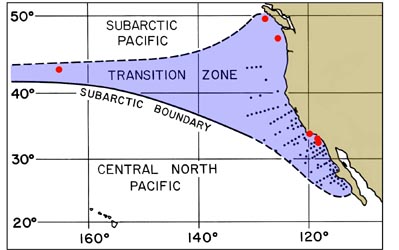
Figure. Location of the Transition Zone faunal province (shaded violet) and records (red dots) of Atlanta californiensis. The black dots are station records for Atlanta sp. of McGowan (1967), many of which, particularly those north of about 34° latitude, are probably A. californiensis. The Transition Zone province is separated from the Central North Pacific province by the Subarctic Boundary and its southeasterly extension to Baja California; it merges more broadly with the Subarctic Pacific province to the north. Drawing modified from Seapy and Richter (1993).
References
Cummings, F. A. and R. R. Seapy. 2003. Seasonal abundances of euthecosomatous pteropods and heteropods from waters overlying the San Pedro Basin, California. Veliger 46: 305-313.
McGowan, J. A. 1967. Distributional atlas of pelagic molluscs in the California Current region. California Cooperative Oceanic Fisheries Investigations, Atlas 6, 218 pp.
Seapy, R. R. 1974. Distribution and abundance of the epipelagic mollusk Carinaria japonica in waters off Southern California. Marine Biology 24: 243-250.
Seapy, R. R. 1990. Patterns of vertical distribution in epipelagic heteropod molluscs off Hawaii. Marine Ecology Progress Series 60: 235-246.
Seapy, R. R. and G. Richter. 1993. Atlanta californiensis, a new species of atlantid heteropod (Mollusca: Gastropoda) from the California Current. Veliger 36: 389-398.
Title Illustrations

| Scientific Name | Atlanta californiensis |
|---|---|
| Location | nearshore waters of California Current off Bodega Head, California |
| Comments | other views and video available at: http://bodegahead.blogspot.com/2014/09/say-hello-to-atlanta.html |
| Specimen Condition | Live Specimen |
| Sex | juvenile |
| Life Cycle Stage | early postmetamorphic |
| View | right side |
| Copyright | © 2014 |
About This Page

California State University, Fullerton, California, USA
Correspondence regarding this page should be directed to Roger R. Seapy at
Page copyright © 2010
 Page: Tree of Life
Atlanta californiensis .
Authored by
Roger R. Seapy.
The TEXT of this page is licensed under the
Creative Commons Attribution License - Version 3.0. Note that images and other media
featured on this page are each governed by their own license, and they may or may not be available
for reuse. Click on an image or a media link to access the media data window, which provides the
relevant licensing information. For the general terms and conditions of ToL material reuse and
redistribution, please see the Tree of Life Copyright
Policies.
Page: Tree of Life
Atlanta californiensis .
Authored by
Roger R. Seapy.
The TEXT of this page is licensed under the
Creative Commons Attribution License - Version 3.0. Note that images and other media
featured on this page are each governed by their own license, and they may or may not be available
for reuse. Click on an image or a media link to access the media data window, which provides the
relevant licensing information. For the general terms and conditions of ToL material reuse and
redistribution, please see the Tree of Life Copyright
Policies.
- First online 22 February 2005
- Content changed 22 February 2010
Citing this page:
Seapy, Roger R. 2010. Atlanta californiensis . Version 22 February 2010. http://tolweb.org/Atlanta_californiensis/28755/2010.02.22 in The Tree of Life Web Project, http://tolweb.org/


