


Magnoteuthis
Richard E. Young and Michael Vecchione

- Magnoteuthis magna (Joubin, 1913)
- Magnoteuthis microlucens (Young, Lindgren & Vecchione 2008)
- Magnoteuthis type beta
Introduction
Magnoteuthis is very distinctive and its members cannot be easily confused with any other mastigoteuthid. Squid in this group can be relatively common in warm temperate to tropical waters. One form is known only from Subantarctic waters.
Brief diagnosis:
A mastigoteuthid with ...
- flask-shaped funnel locking-apparatus.
- very small (0.05 mm) tentacular club suckers.
Characteristics
- Arms
- Largest arm suckers in mid-arm rather than at or near arm base.
- Largest arm suckers in mid-arm rather than at or near arm base.
- Tentacles
- Tentacular club suckers of uniform size throughout
- Tentacular club suckers extremely small, ca. 0.05 mm in diameter.
Click on an image to view larger version & data in a new window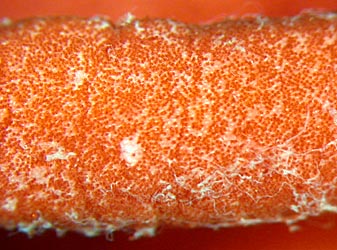
Figure. Oral view of the mid-region of the tentacular club of Mg. magna, 160 mm ML, preserved. The red dots are the suckers. Photograph by R. Young.
- Tentacular club suckers of uniform size throughout
- Head
- Funnel pocket absent.
Click on an image to view larger version & data in a new window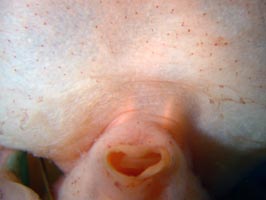
Figure. Ventral view of head and funnel of Mg. microlucens. showing the absence of a deep pocket between the funnel-adductor muscles. Photograph by R. Young.
- Funnel
- Funnel with flask-shaped locking-apparatus.
Click on an image to view larger version & data in a new window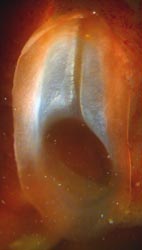
Figure. Frontal and slightly oblique view of the funnel locking-groove of Mg. magna. Photograph by R. Young.
- Fins
- Fin length usually 55-65% of ML.
- Fin length usually 55-65% of ML.
- Tubercules
- Tubercules absent from the integument.
- Tubercules absent from the integument.
- Photophores and pigmentation
- Integumental photophores absent or microscopic in size (ca. one third diameter of integumental photophores of other members of the family - see Mg. microlucens).
- Pigment mostly in densely spaced chromatophores (possible exception in Mg. type beta).
Click on an image to view larger version & data in a new window
Figure. Frontal view of the skin of Mg. magna, under high magnification. Photograph by M. Vecchione.
- Integumental photophores absent or microscopic in size (ca. one third diameter of integumental photophores of other members of the family - see Mg. microlucens).
Comparison of "species"
Here we compare the structure of the arm suckers (club suckers are similar in all forms), the funnel locking-apparatus, photophores and pigmentation of the three forms. Other differences exist (eg, beaks) but these most apparent ones.
- Arm suckers: Mg. magna suckers have smooth inner rings although a hint of teeth can sometimes be seen in parallel lines on the ring. Mg. "type beta" has small distinct teeth on the distal margin of the inner ring while Mg. microlucens generally has a few broad, rounded teeth, fused together over most of their lengths.
- Funnel locking-apparatus: Mg. magna has a straight, anterior groove and a broad, posterior cup. Mg. "type beta" has a broad groove that flares posteriorly and a rather elongate, posterior cup. Mg. microlucens has a slender a slender, anterior groove and a rather elongate, posterior cup. These features are often easier to recognize, in reverse, that is in the mantle component of the locking-apparatus.
- Photophores: Photophores are known only in Mg. microlucens.
- Pigmentation: Pigmentation is poorly understood except in Mg. magna which is covered with a dense array of red chromatophores. Mg. "type beta" appears to be lightly pigmented and may lack chromatophores. Mg. microlucens is pigmented similar to Mg. magna but pigment may not be as dense in young individuals of Mg. microlucens.
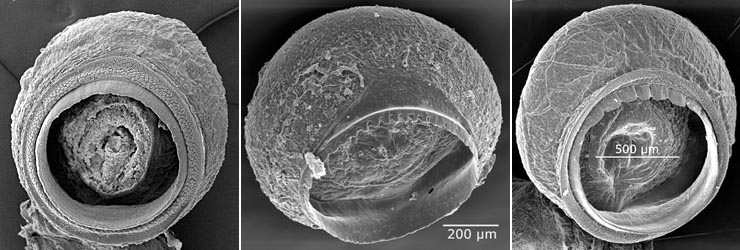
Figure. Oral or oral-oblique views of large arm suckers of Magnoteuthis spp. Left - Mg. magna, North Atlantic. Middle - Mg. "type beta", Subantarctic Pacific. Right - Mg. microlucens, Hawaiian waters, central N. Pacific. Photographs by R. Young.
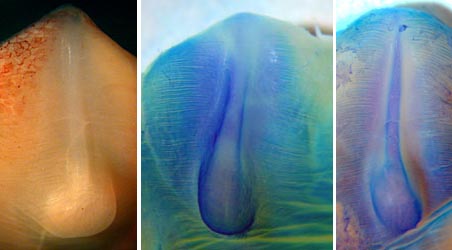
Figure. Frontal views of the mantle components of the funnel locking apparatuses in Mastigopsis spp.. Left - Mg. magna, North Atlantic. Middle - Mg. "type beta", Subantarctic Pacific. Right - Mg. microlucens, Hawaiian waters, central N. Pacific. Photographs by R. Young.
Comments
The specific status of Mg. "type beta" is uncertain since only one individual is known and its pigmentation, its most distinctive feature, is uncertain due to some damage during capture.
Title Illustrations

| Scientific Name | Mastigoteuthis magna |
|---|---|
| Comments | Ventral view. |
| Reference | Joubin, L. 1920. Céphalopodes provenant des Campagnes de la Princesse Alice (1898-1910). 3e Serie. Monaco. |
| Size | 160 mm ML |
| Type | Holotype |
About This Page

University of Hawaii, Honolulu, HI, USA
National Museum of Natural History, Washington, D. C. , USA
Page copyright © 2019 and
 Page: Tree of Life
Magnoteuthis .
Authored by
Richard E. Young and Michael Vecchione.
The TEXT of this page is licensed under the
Creative Commons Attribution-NonCommercial License - Version 3.0. Note that images and other media
featured on this page are each governed by their own license, and they may or may not be available
for reuse. Click on an image or a media link to access the media data window, which provides the
relevant licensing information. For the general terms and conditions of ToL material reuse and
redistribution, please see the Tree of Life Copyright
Policies.
Page: Tree of Life
Magnoteuthis .
Authored by
Richard E. Young and Michael Vecchione.
The TEXT of this page is licensed under the
Creative Commons Attribution-NonCommercial License - Version 3.0. Note that images and other media
featured on this page are each governed by their own license, and they may or may not be available
for reuse. Click on an image or a media link to access the media data window, which provides the
relevant licensing information. For the general terms and conditions of ToL material reuse and
redistribution, please see the Tree of Life Copyright
Policies.
- First online 19 November 2007
- Content changed 06 December 2014
Citing this page:
Young, Richard E. and Michael Vecchione. 2014. Magnoteuthis . Version 06 December 2014 (under construction). http://tolweb.org/Magnoteuthis/65303/2014.12.06 in The Tree of Life Web Project, http://tolweb.org/


