- Arms
- The photograph below shows the arms of the mature male holotype. The proximal and distal fields of enlarged suckers are apparent.
 Click on an image to view larger version & data in a new window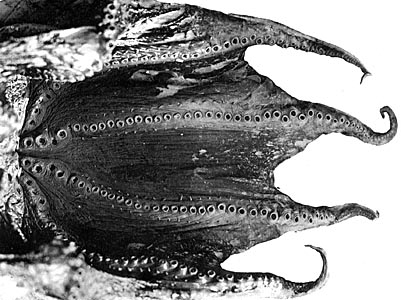
Figure. Oral view of the dorsal arms of O. grimaldii, holotype. Photograph from Joubin, 1920.
- Eyes
- Large, 45% of ML.
- Large, 45% of ML.
- Funnel
- Funnel organ with two, separate, elongate pads.
- Funnel organ with two, separate, elongate pads.
- Fins
- Without lobe near anterior insertion in preserved animals.
- Fin span ca. 4 times fin length.
- Gills
- Small, half-orange appearance.
- 7 or 8 primary lamellae per gill.
- Optic lobes and nerves
- Optic lobes kidney-shaped.
- Two or three optic nerve bundles pass through/by white body.
Click on an image to view larger version & data in a new window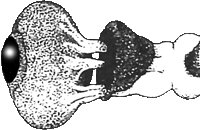
Figure. Ventral view of the eye, optic nerve tracts, white body and optic lobe of O. grimaldii. Drawing from Villanueva et al. (2002).
- Digestive tract
- Radula absent.
- Glandular-like area on buccal mass [presumably the posterior salivary glands].
- Esophagus dialated forming crop-like structure.
- Digestive gland bilobed.
- Intestine apparently slightly shorter than esophagus; forms S-shape.
Click on an image to view larger version & data in a new window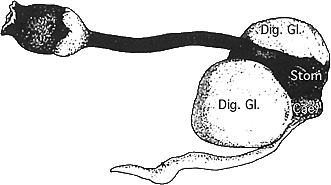
Figure. Lateral view of digestive tract of O. grimaldii. Drawing from Villanueva et al. (2002).
- Beaks
- Lower beak pointed; hood small; without folds or ridges on lateral walls.
Click on an image to view larger version & data in a new window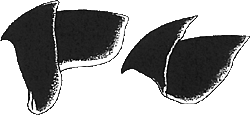
Figure. Lateral views of lower beak (left) and upper beak (right) of O. grimaldii. Drawing from Villanueva et al. (2002).
- Male reproductive system
- Accessory glands "2 and 3" approximately equal in size.
- Penis relatively long.
- Spermatophores oval, 1-2 mm long.
Click on an image to view larger version & data in a new window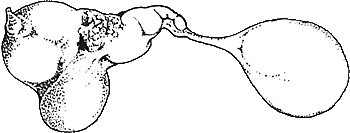
Figure. Reproductive tract of O. grimaldii, mature male, 42 mm ML. Drawing from Villanueva et al. (2002).
- Female reproductive system
- Unknown as females cannot be identified with certainty.
- Unknown as females cannot be identified with certainty.
- Shell
- Stout with short, flaring lateral wings.
- Outer surface of saddle flat, without inrolling ridges; inner surface convex.
- Lateral wings taper to acute points.
Click on an image to view larger version & data in a new window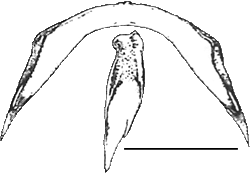
Figure. Dorsal (top) and lateral (bottom) views of the shell of O. grimaldii, mature male, 45 mm ML. Bar is 20 mm. Drawing from Villanueva et al. (2002).
- Pigmentation
- Octopod reddish-brown in preserved specimens.
- Areolae not observed in eastern Atlantic specimens.
- Measurements
Comments
Except for the first illustration, the above description is taken from Villanueva et al. (in press).


