


Carinaria challengeri
Roger R. Seapy
Introduction
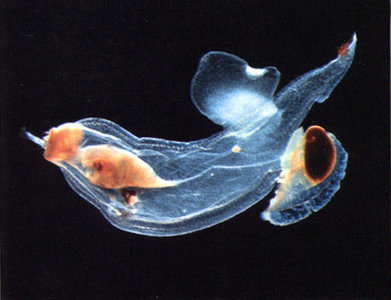
Carinaria challengeri is a small species (to 40 mm body length). One striking feature of the species immediately distinguishes it from C. lamarcki; a pair of reddish-brown hemispherical structures on the ventral surface of the tail. Otherwise, C. challengeri basically shares its external morphology with C. lamarcki. Minor differences include a proboscis and trunk with a somewhat thinner cutis, a more broadly triangular shell (when viewed from the side), and a shorter tail.
Brief Diagnosis
A species of Carinaria with:
- Body length up to 40 mm
- Shell shape broadly triangular when viewed from the side
- Tail short and, like C. lamarcki, lacks the thickened cutis of the proboscis and trunk
- Tail with a low dorsal crest
- Tail with a distinctive ventral pair of reddish-brown hemispherical structures
Characteristics
- Body
- Body short (maximal length = 40 mm; Bonnevie (1920). In basic agreement, the largest specimen recorded by Pafort-van Iersel (1983) from midwater trawl tows in the North Atlantic was 35 mm
- Proboscis and trunk with a cutis that is thinner than in C. lamarcki (see title illustration), and with more numerous and smaller tubercles on the surface
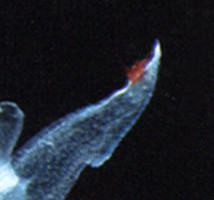
- Tail smaller than in C. lamarcki, but also lacks the thickened cutis of the proboscis and trunk and has a low dorsal crest (see photograph below)
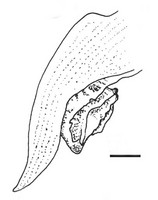
- Pair of reddish-brown, hemispherical structures located posteriorly on the tail, on either side of the ventral midline (see photograph and drawing below). Because of their location and possible function in mating, Bonnevie (1920) termed them "claspers". However, Tesch (1949) reported little to no musculature associated with the structures and concluded that they probably could not serve to hold partners together during mating. An alternative name and function for the structures has not been proposed Click on an image to view larger version & data in a new window
 Click on an image to view larger version & data in a new window
Figure. Left: Tail of Carinaria challengeri (enlarged from title illustration). © A. de Vera. Right: Drawing of posterior portion of the tail, with details of the hemispherical "claspers". Scale bar = 0.5 mm. From Richter and Seapy (1999; modified from Bonnevie, 1920).
- Additional differences between this species and C. lamarcki cited by Pafort-van Iersel (1983) include: (1) visceral nucleus darker and on a shorter stalk, (2) retinal base of eyes more darkly pigmented; and, (3) tentacles more strongly developed, with the left one distinctly longer than the right one.
- Shell
- The shell is broadly triangular when viewed from the right side, with the height about one-half of the basal length (see photograph below)
- Keel moderately low and increases in height with proximity to the shell aperture (see photograph below)
Click on an image to view larger version & data in a new window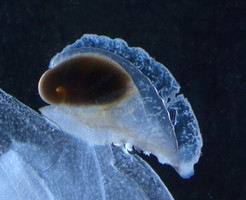
Figure. Close up of visceral nucleus and shell of Carinaria challengeri, viewed from the right side of the body. Note the brown digestive gland extending into the coiled protoconch (poserior end of shell). © Alejandro de Vera
Comments
Carinaria challengeri was originally described as a variety of C. lamarcki by Bonnevie (1920). This designation was followed by subsequent authors (see Spoel, 1976) until the geographic and vertical distribution study by Pafort-van Iersel (1983) based on opening-closing, paired 1-m2 and 8-m2 midwater trawl samples collected along a north-south transect in the mid North Atlantic. She reported that the two varieties of C. lamarcki (termed "formae" by Spoel, 1976) overlapped along the expedition's north to south transect (at 30º W Longitude); C. lamarcki lamarcki between 32° and 49ºN and C. lamarcki challengeri between 40º and 45ºN. Since no specimens in the range of overlap could be distinguished as morphologically intermediate between the two varieties, Pafort-van Iersel concluded that the two varieties should be accorded separate species status as C. lamarcki and C. challengeri.
As Pafort-van Iersel (1983) had reported for Carinaria lamarcki, no C. challengeri were captured by the smaller of the paired 1-m2 and 8-m2 midwater trawl nets employed during in the study. As with C. lamarcki, this result suggests either that the probability of capture by the smaller net was very low (and was an anomaly) or that the species was able to avoid capture by the smaller net. An hypothesis of net avoidance by visual detection of an oncoming net is supported by the result that while a total of six animals were captured at night, only one was taken during the day (from a 100-200 m tow) and one at twilight (a 50-100 m tow). At night three individuals were captured from 100-200 m and three from 50-100 m. Based on these limited results, one can only postulate that C. challengeri is limited to the upper 200 m of the water column.
References
Bonnevie, Kr. 1920. Heteropoda, pp. 3-17, 5 plates. In: Report on the scientific results of the "Michael Sars" North Atlantic deep-sea expedition 1910. Part 3, No. 2, 1913-1921.
de Vera, A., R. R. Seapy, and F. Hernandez. 2006. Heteropod molluscs from waters around the Selvagens Islands (Gastropoda: Carinarioidea). Vieraea 34: 33-43.
Pafort-van Iersel, T. 1983. Distribution and variation of Carinariidae and Pterotracheidae (Heteropoda, Gastropoda) of the Amsterdam Mid North Atlantic Plankton Expedition 1980. Beaufortia 33: 73-96.
Richter, G. and R. R. Seapy. 1999. Heteropoda, pp. 621-647. In: D. Boltovskoy (ed.), South Atlantic Zooplankton. Backhuys Publishers, Leiden.
Spoel, S. van der. 1976. Pseudothecosomata, Gymnosomata and Heteropoda (Gastropoda). Bohn, Scheltema and Holkema, Utrecht. 484 pp.
Tesch, J. J. 1949. Heteropoda. Dana Report 34, 53 pp., 5 plates.
Title Illustrations

| Scientific Name | Carinaria challengeri |
|---|---|
| Location | Selvagens Islands waters, North Atlantic Ocean |
| Reference | de Vera, A., R. R. Seapy and F. Hernandez. 2006. Heteropod molluscs from waters around the Selvagens Islands (Gastropoda: Carinarioidea). Vieraea: 34: 33-43 (Fig. 3C) |
| Specimen Condition | Dead Specimen |
| Sex | Female |
| Life Cycle Stage | adult |
| View | right side |
| Copyright | © Museo de Ciencias Naturales de Tenerife |
About This Page

California State University, Fullerton, California, USA
Correspondence regarding this page should be directed to Roger R. Seapy at
Page copyright © 2008
 Page: Tree of Life
Carinaria challengeri .
Authored by
Roger R. Seapy.
The TEXT of this page is licensed under the
Creative Commons Attribution License - Version 3.0. Note that images and other media
featured on this page are each governed by their own license, and they may or may not be available
for reuse. Click on an image or a media link to access the media data window, which provides the
relevant licensing information. For the general terms and conditions of ToL material reuse and
redistribution, please see the Tree of Life Copyright
Policies.
Page: Tree of Life
Carinaria challengeri .
Authored by
Roger R. Seapy.
The TEXT of this page is licensed under the
Creative Commons Attribution License - Version 3.0. Note that images and other media
featured on this page are each governed by their own license, and they may or may not be available
for reuse. Click on an image or a media link to access the media data window, which provides the
relevant licensing information. For the general terms and conditions of ToL material reuse and
redistribution, please see the Tree of Life Copyright
Policies.
- First online 08 July 2008
- Content changed 08 July 2008
Citing this page:
Seapy, Roger R. 2008. Carinaria challengeri . Version 08 July 2008. http://tolweb.org/Carinaria_challengeri/28746/2008.07.08 in The Tree of Life Web Project, http://tolweb.org/


