


Cephalotini


Characteristics
The Cephalotini share the following synapomorphies with Cataulacus (Bolton 2003):- Abdominal segment III with tergosternal fusion
- Tergite of abdominal segment IV hypertrophied, comprising entire dorsum of gaster in dorsal view
- Ileum dilated and thickened to accommodate microorganisms
- Proventriculus mushroom-shaped, with a sclerotized cuticular framework
References
Bolton, B. 1994. Identification Guide to the Ant Genera of the World. Cambridge, MA: Harvard University Press.
Bolton, B. 1995. A New General Catalogue of the Ants of the World. Cambridge, MA: Harvard University Press.
Bolton, B. 2003. Synopsis and Classification of Formicidae. 370 pp. Memoirs of the American Entomological Institute, Vol. 71. Gainesville, FL.
De Andrade, M. L. and C. Baroni Urbani. 1999. Diversity and adaptation in the ant genus Cephalotes, past and present. Stuttgarter Beiträge zur Naturkunde. Serie B (Geologie und Paläontologie) 271: 1-889.
Hölldobler, B. and E. O. Wilson. 1990. The Ants. Cambridge, MA: Harvard University Press.
Kempf, W. W. 1951. A taxonomic study on the ant tribe Cephalotini. Revista de Entomologia 22: 1-244.
Kempf, W. W. 1958. New studies on the ant tribe Cephalotini. Studia Entomologica (N.S.) 1: 1-176.
Wheeler, G. C. & Wheeler, J. 1976. Ant larvae: review and synthesis. Memoirs of the Entomological Society of Washington 74: 1-108.
Title Illustrations

| Scientific Name | Cephalotes umbraculatus |
|---|---|
| Location | Guatemala |
| Sex | Female |
| Life Cycle Stage | Major worker |
| Copyright |
© 2003 Alex Wild

|
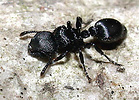
| Scientific Name | Procryptocerus scabriusculus |
|---|---|
| Location | Guatemala |
| Sex | Female |
| Life Cycle Stage | Worker |
| Copyright |
© 2003 Alex Wild
|
About This Page
Page copyright © 2004
 Page: Tree of Life
Cephalotini.
The TEXT of this page is licensed under the
Creative Commons Attribution-NonCommercial License - Version 3.0. Note that images and other media
featured on this page are each governed by their own license, and they may or may not be available
for reuse. Click on an image or a media link to access the media data window, which provides the
relevant licensing information. For the general terms and conditions of ToL material reuse and
redistribution, please see the Tree of Life Copyright
Policies.
Page: Tree of Life
Cephalotini.
The TEXT of this page is licensed under the
Creative Commons Attribution-NonCommercial License - Version 3.0. Note that images and other media
featured on this page are each governed by their own license, and they may or may not be available
for reuse. Click on an image or a media link to access the media data window, which provides the
relevant licensing information. For the general terms and conditions of ToL material reuse and
redistribution, please see the Tree of Life Copyright
Policies.
- First online 26 April 2004
Citing this page:
Tree of Life Web Project. 2004. Cephalotini. Version 26 April 2004 (temporary). http://tolweb.org/Cephalotini/22434/2004.04.26 in The Tree of Life Web Project, http://tolweb.org/


