


Dorylomorphs
Army ants and their relatives
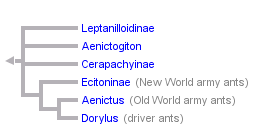


This tree diagram shows the relationships between several groups of organisms.
The root of the current tree connects the organisms featured in this tree to their containing group and the rest of the Tree of Life. The basal branching point in the tree represents the ancestor of the other groups in the tree. This ancestor diversified over time into several descendent subgroups, which are represented as internal nodes and terminal taxa to the right.
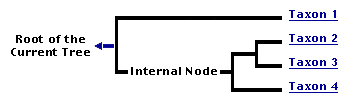
You can click on the root to travel down the Tree of Life all the way to the root of all Life, and you can click on the names of descendent subgroups to travel up the Tree of Life all the way to individual species.
For more information on ToL tree formatting, please see Interpreting the Tree or Classification. To learn more about phylogenetic trees, please visit our Phylogenetic Biology pages.
close boxCharacteristics
The dorylomorph subfamilies are characterized by the following synapomorphies (Bolton 2003):- Prementum not visible when mouthparts closed, completely concealed behind labrum and outgrowths of the maxillae that meet medially
- Metatibial gland present, located distally on the ventral surface
- Metapleural gland orifice concealed beneath a ventrally directed cuticular flap or flange
- Sternite of helcium large, bulging ventrally and visible in profile
- Spiracles of abdominal segments V-VII shifted posteriorly on each segment, not concealed by the posterior margin of the preceding tergite and visible without distension or dissection
- Pygidium modified: either large and with dorsum flattened and armed with teeth or spines, or reduced to a narrow U-shaped sclerite
References
Bolton, B. 1990a. Abdominal characters and status of the cerapachyine ants. Journal of Natural History 24: 53-68.
Bolton, B. 1990b. Army ants reassessed: the phylogeny and classification of the doryline section. Journal of Natural History 24: 1339-1364.
Bolton, B. 1994. Identification Guide to the Ant Genera of the World. Cambridge, MA: Harvard University Press.
Bolton, B. 1995. A New General Catalogue of the Ants of the World. Cambridge, MA: Harvard University Press.
Bolton, B. 2003. Synopsis and Classification of Formicidae. 370 pp. Memoirs of the American Entomological Institute, Vol. 71. Gainesville, FL.
Brady, S. 2003. Evolution of the army ant syndrome: the origin and long-term evolutionary stasis of a complex of behavioral and reproductive adaptations. PNAS 100(11): 6575-6579.
Brown, W. L., Jr. 1975. Contributions toward a reclassification of the Formicidae. 5. Ponerinae, tribes Platythyreini, Cerapachyini, Cylindromyrmecini, Acanthostichini, and Aenictogitini. Search Agriculture 5. Entomology (Ithaca) 15: 1-115.
Gotwald, W. H., Jr. 1979. Phylogenetic implications of army ant zoogeography (Hymenoptera: Formicidae). Annals of the Entomological Society of America. 72 (4): 462-467.
Gotwald, W. H., Jr and A. W. Burdette. 1981. Morphology of the male internal reproductive system in army ants: phylogenetic implications. Proceedings of the Entomological Society of Washington 83: 72-92.
Hölldobler, B. and E. O. Wilson. 1990. The Ants. Cambridge, MA: Harvard University Press.
Perfil'eva, K. S. 2002. Wing venation in army ants (Hymenoptera, Formicidae) and its importance for phylogeny. Zoologicheskii Zhurnal 81 (10): 1239-1250.
Wheeler, G. C. & Wheeler, J. 1976. Ant larvae: review and synthesis. Memoirs of the Entomological Society of Washington 74: 1-108.
About This Page
Page copyright © 2004
 Page: Tree of Life
Dorylomorphs. Army ants and their relatives.
The TEXT of this page is licensed under the
Creative Commons Attribution-NonCommercial License - Version 3.0. Note that images and other media
featured on this page are each governed by their own license, and they may or may not be available
for reuse. Click on an image or a media link to access the media data window, which provides the
relevant licensing information. For the general terms and conditions of ToL material reuse and
redistribution, please see the Tree of Life Copyright
Policies.
Page: Tree of Life
Dorylomorphs. Army ants and their relatives.
The TEXT of this page is licensed under the
Creative Commons Attribution-NonCommercial License - Version 3.0. Note that images and other media
featured on this page are each governed by their own license, and they may or may not be available
for reuse. Click on an image or a media link to access the media data window, which provides the
relevant licensing information. For the general terms and conditions of ToL material reuse and
redistribution, please see the Tree of Life Copyright
Policies.
- First online 21 October 2004
Citing this page:
Tree of Life Web Project. 2004. Dorylomorphs. Army ants and their relatives. Version 21 October 2004 (temporary). http://tolweb.org/Dorylomorphs/22227/2004.10.21 in The Tree of Life Web Project, http://tolweb.org/

