


Pterotrachea hippocampus
Roger R. Seapy
Introduction
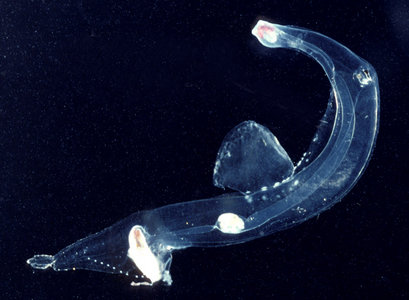
The body morphology of Pterotrachea hippocampus is elongate; similar to that in P. coronata but not as streamlined (see the P. coronata page). Instead, the proboscis is shorter and thicker, the visceral nucleus is shorter and pyriform (teardrop) shaped, and the tail is shorter and less well developed. The eye shape is unique in the genus, with a narrowly- to broadly-triangular shape. The trunk cutis anterior to the swimming fin is thickened ventrolaterally, forming a bib, and the tail terminates in two small leaf-like lobes, as in P. coronata. Like the other species of Pterotrachea, a swimming fin sucker is present only in males. The geographical distribution is cosmopolitan in tropical to subtropical waters.
Brief Diagnosis
A species in the genus Pterotrachea with the following characteristics:
- Body elongate, comparable in form with P. coronata
- Proboscis similar to that in P. coronata, but shorter and thicker
- Trunk cutis anterior to swimming fin thickened as ventrolateral folds, forming a bib
- Visceral nucleus pyriform (teardrop) shaped, like that in P. scutata
- Eye shape, in dorsal view, narrowly to broadly trianguler
Characteristics
- Body morphology
- Proboscis tubular and moderately long (see title illustration); relatively shorter and thicker than in P. coronata
- Trunk cutis anterior to swimming fin thickened ventrolaterally, forming a bib (see title illustration)
- Viewed dorsally, eyes narrowly (juveniles) to broadly (adults) triangular in shape. Change in shape due to lengthening of the retinal base (compare the three photographs below), which can be quantified by the ratio of the eye length to retinal base width. In Hawaiian P. hippocampus this ratio decreases from 1.6 in juveniles to 1.0 in adults (Seapy, 1985)
Click on an image to view larger version & data in a new window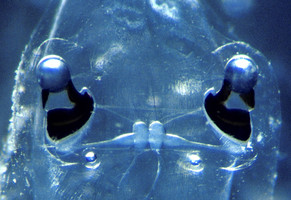
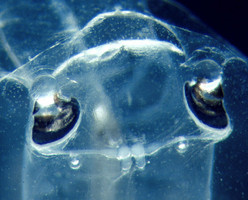
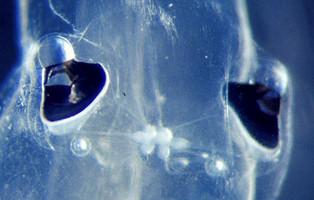
Click on an image to view larger version & data in a new windowClick on an image to view larger version & data in a new windowFigure. Eye shape in Pterotrachea hippocampus as a function of age. Left: eyes in a juvenile specimen, ca. 15-20 mm body length. Center: eyes in a young adult, ca. 30-35 mm body length. Right: eyes in a old adult, ca. 50-55 mm body length. ©
- Visceral nucleus pyriform, or teardrop, shaped. In Hawaiian specimens (Seapy, 1985) the length to width ratio averages 2.9 and decreases gradually with age (Seapy, 1985). This average value is nearly identical with that for P. scutata (3.0) but differs dramatically with that for P. coronata (4.8) Click on an image to view larger version & data in a new window
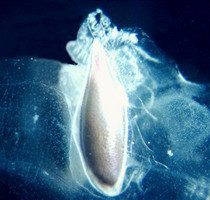
Figure. Lateral view of the visceral nucleus in Pterotrachea hippocampus.©
- Swimming fin sucker medial on the ventral margin of the fin Click on an image to view larger version & data in a new window
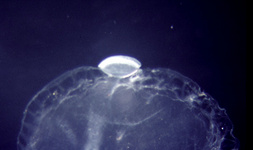
Figure. Ventral portion of the swimming fin and sucker in Pterotrachea hippocampus, viewed from the right side of the body with the ventral margin directed upward. ©
- Swimming fin closer to the visceral nucleus than the head (see title illustration), like in P. coronata
- Proboscis tubular and moderately long (see title illustration); relatively shorter and thicker than in P. coronata
- Shell present only in larvae and is cast off at metamorphosis
- Larva unknown, but is probably represented by either larva 2 or 3 of Richter (1968); see Pterotrachea larvae
- Radular morphology similar to that in the other species in the genus, with the median cusp of the central, or rachidian, tooth conspicuously broader and longer than the lateral cusps (see SEM below)
Click on an image to view larger version & data in a new window
Figure. Scanning electron micrograph of central, or rachidian, tooth (bottom center of photograph) in Pterotrachea hippocampus. From Richter and Seapy (1999, Fig. 4D). Scale bar = 20 µm. © G. Richter
Comments
Taxonomy: The validity of Pterotrachea minuta Bonnevie 1920 was not questioned until a morphological analysis of the species in the genus Pterotrachea from Hawaiian waters was undertaken by Seapy (1985). Specimens tentatively identified either as P. hippocampus or P. minuta over a broad size range revealed a continuum of change in the shape of the eyes and the visceral nucleus (the two primary criteria used historically to distinguish the two species). Regardless of the initial tentative species identification, young individuals possessed narrowly triangular eyes and longer visceral nuclei which, with growth, transitioned to broadly triangular eyes and shorter visceral nuclei in older adults. The conclusion of the study was that there was no justification for recognizing P. minuta as a valid species; at least in the North Pacific Ocean. A subsequent morphological comparison of specimens collected from the North Atlantic Ocean that had been previously assigned to P. minuta and P. hippocampus was undertaken by Seapy (2000). In addition to eye and visceral nuleus shape, all of the other characters cited by Bonnevie (1920) to distinguish the two species were examined. The results confirmed and amplified upon those of the earlier Hawaiian study.
Ecology: Among the heteropods collected during the Meteor Expedition in the northwestern Indian Ocean (Richter, 1974), Pterotrachea hippocampus was rare; only four individuals were recorded. From the Amsterdam Mid North Atlantic Plankton Expedition (Pafort-van Iersel, 1983), a total of 72 P. hippocampus were captured, which was comparable with the total for P. scutata (74) but only one-half the number of P. coronata (146). Opening-closing midwater trawl tows were made along a north-south transect (approximately at 30°W longitude) between 25°N and 49°N. Nine individuals were collected between 36°N and 49°N, while the rest were from 25°N to 35°N. Although extending somewhat into subtemperate waters, these records support the general observation that the P. hippocampus is a tropical to subtropical species. In a diel vertical distribution study of heteropods from Hawaiian waters of the North Pacific (Seapy, 1990), P. hippocampus was the second most abundant heteropod species (20% of the total), behind Atlanta lesueurii (29%). However, in a subsequent study from Hawaiian waters (Seapy, 2008), P. hippocampus was recorded in very low numbers; ranking eighth of twelve species (mean nighttime density = 1.2% of the total) in a fall sampling period and eleventh of seventeen species (mean nighttime density = 0.2%) in a spring period. The striking difference between the abundances in the two studies suggests that the species' abundance in Hawaiian waters is highly variable.
Vertical distributions of carinariids and pterotracheids in the central North Atantic were reported by Pafort-van Iersel (1983) based on samples collected with paired 1-m2 and 8-m2 opening-closing midwater trawls. Pterotrachea hippocampus (data for P. hippocampus and P. minuta combined) was mainly recorded from the upper 200 m (eleven tows and 50 specimens); below 200 m only ten specimens were captured by six tows. These results suggest that the species is primarily epipelagic (upper 200 m), although its range extends into the mesopelagic zone in low numbers. Also, there was no evidence for nocturnal vertical migration by individuals below 200 m since equal numbers were recorded from the day and night tows. In Hawaiian waters the large numbers of P. hippocampus collected in the study by Seapy (1990) provided a large data set with which to investigate diel vertical distribution patterns in the epipelagic zone (0-400 m). The species ranged downward to 300 m during both day and night periods, although the abundance below 200 m was low. During the day the highest mean densities were at the 90-140 m and 140-200 m depth intervals, while at night the highest densities were in the 0-45 and 45-90 m intervals. These data support an hypothesis of nocturnal vertical migration into the upper 90 m by a large portion of the population living between 90 and 200 m during the day.
References
Bonnevie, Kr. 1920. Heteropoda, pp. 3-17, 5 plates. In: Report on the scientific results of the "Michael Sars" North Atlantic deep-sea expedition 1910. Part 3, No. 2, 1913-1921.
Lalli, C. M. and R. W. Gilmer. 1989. Pelagic snails. The biology of holoplanktonic gastropod mollusks. Stanford University Press, Stanford. 259 pp.
Pafort-van Iersel, T. 1983. Distribution and variation of Carinariidae and Pterotracheidae (Heteropoda, Gastropoda) of the Amsterdam Mid North Atlantic Plankton Expedition 1980. Beaufortia 33: 73-96.
Richter, G. 1968. Heteropoden und Heteropodenlarven im Oberflächenplankton des Golfs von Neapel. Pubblicazioni della Stazione Zoologica di Napoli 36: 346-400.
Richter, G. 1974. Die Heteropoden der "Meteor" Expedition in den Indischen Ozean 1964/65. "Meteor" Forschungs-Ergibnisse Ser. D, No. 17, pp. 55-78.
Richter, G. and R. R. Seapy. 1999. Heteropoda, pp. 621-647. In: D. Boltovskoy (ed.), South Atlantic Zooplankton. Backhuys Publishers, Leiden.
Seapy, R. R. 1985. The pelagic genus Pterotrachea (Gastropoda: Heteropoda) from Hawaiian waters: a taxonomic review. Malacologia 26(1-2): 125-135.
Seapy, R. R. 1990. Patterns of vertical distribution in epipelagic heteropod molluscs off Hawaii. Marine Ecology Progress Series 60: 235-246.
Seapy, R. R. 2000. Species discrimination among pelagic heteropods: resolution of the Pterotrachea hippocampus - P. minuta problem. Journal of Molluscan Studies 66: 99-117.
Seapy, R. R. 2008. Offshore-onshore and vertical distributional patterns of heteropod mollusks off leeward Oahu, Hawaii. Marine Biology 154: 985-995.
Title Illustrations

| Scientific Name | Pterotrachea hippocampus |
|---|---|
| Location | Hawaiian waters |
| Specimen Condition | Live Specimen |
| Sex | Female |
| Life Cycle Stage | adult |
| View | left side of body |
| Image Use |
 This media file is licensed under the Creative Commons Attribution-NonCommercial License - Version 3.0. This media file is licensed under the Creative Commons Attribution-NonCommercial License - Version 3.0.
|
| Copyright |
©

|
About This Page
California State University, Fullerton, California, USA
Correspondence regarding this page should be directed to Roger R. Seapy at
Page copyright © 2007
 Page: Tree of Life
Pterotrachea hippocampus .
Authored by
Roger R. Seapy.
The TEXT of this page is licensed under the
Creative Commons Attribution License - Version 3.0. Note that images and other media
featured on this page are each governed by their own license, and they may or may not be available
for reuse. Click on an image or a media link to access the media data window, which provides the
relevant licensing information. For the general terms and conditions of ToL material reuse and
redistribution, please see the Tree of Life Copyright
Policies.
Page: Tree of Life
Pterotrachea hippocampus .
Authored by
Roger R. Seapy.
The TEXT of this page is licensed under the
Creative Commons Attribution License - Version 3.0. Note that images and other media
featured on this page are each governed by their own license, and they may or may not be available
for reuse. Click on an image or a media link to access the media data window, which provides the
relevant licensing information. For the general terms and conditions of ToL material reuse and
redistribution, please see the Tree of Life Copyright
Policies.
- First online 22 September 2008
- Content changed 22 September 2008
Citing this page:
Seapy, Roger R. 2008. Pterotrachea hippocampus . Version 22 September 2008. http://tolweb.org/Pterotrachea_hippocampus/28739/2008.09.22 in The Tree of Life Web Project, http://tolweb.org/


