


Vitreledonellinae
Vitreledonella richardi

Introduction
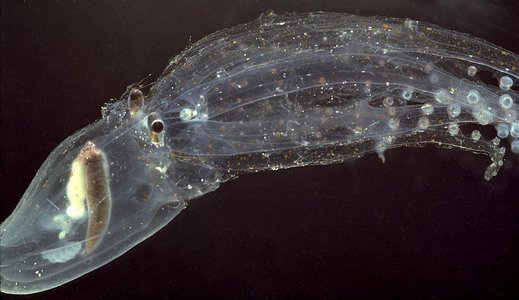
Little information exists on the biology or ecology of this pelagic octopod. It has a cosmopolitan distribution in tropical and subtropical waters where it lives at meso- to bathypelagic depths. The body is gelatinous, transparent and almost colourless. The peculiar long, narrow shape and position of the digestive gland is seen in the title photograph. The stomach and caecum, unlike most other octopods, is reportedly located anterior to the digestive gland. The photo, however, indicates that, in the living octopod, it actually lies on the dorsal surface of the transversely oriented digestive gland.Brief diagnosis:
An amphitretid octopod ...
- with heteroglossan radula.
- with left arm IV hectocotylized.
- With retangular-shaped eyes in frontal view.
Characteristics
- Arms
- Suckers in single series, widely separated from one another.
- Left arm III hectocotylized; spherical vesicle present near tip; other arms, in males, with suckers abruptly enlarged beyond web.Click on an image to view larger version & data in a new window
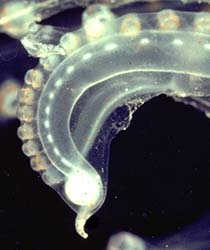
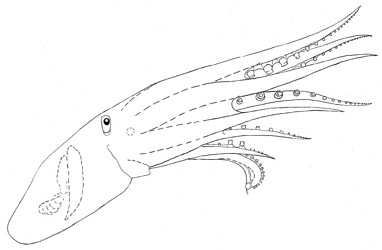
Figure. V. richardi, Hawaiian waters. Left - Side view of the tip of the hectocotylus which has.an unusual oval vesicle with a slender papilla at its tip. Right - Drawing the the octopod showing the hectocotylized left arm III. Photograph by R. Young, drawing from Hochberg, et al. 1992.
- Head
- Eye: Strongly laterally compressed. Shape nearly rectangular in lateral view of octopod; eye width equal to lens diameter; ventral, blunt rostrum-like extension on eye with iridescent tissue.
Click on an image to view larger version & data in a new window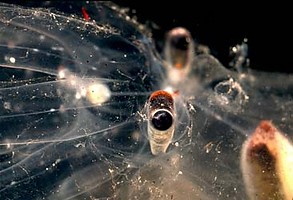
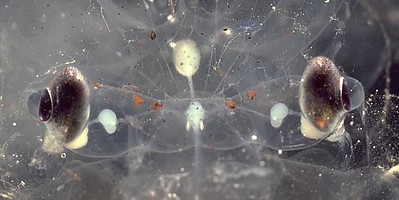
Figure. V. richardi, Hawaiian waters. Left -Lateral view of head (frontal view of eye) showing the unusual shape of the eye. Right - Dorsal view of head showing long optic stalks. Photographs by R. Young.
- Beaks: Descriptions can be found here: Lower beak; upper beak.
- Eye: Strongly laterally compressed. Shape nearly rectangular in lateral view of octopod; eye width equal to lens diameter; ventral, blunt rostrum-like extension on eye with iridescent tissue.
- Mantle
- Mantle opening broad.
- Mantle opening broad.
- Viscera
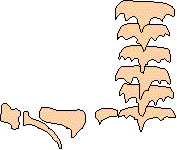
Radula of V. richardi.
Modified from S. Thore (1949).- Radula with multicuspid rhachidian (with a-seriation) and unicuspid first and second lateral teeth (= heteroglossan radula) (drawing on right).
- Digestive gland long and slender, spindle-shaped.
- Stomach dorsal to digestive gland.
Nomenclature
A list of all nominal genera and species in the Vitreledonellinae can be found here. The list includes the current status and type species of all genera, and the current status, type repository and type locality of all species and all pertinent references.Life History
Mating in pelagic octopods poses some problems. Male argonautoids have solved this simply by detaching a hectocotylized arm and giving it to the female. One submersible observation on Vitreledonella suggests that they mate a bit differently: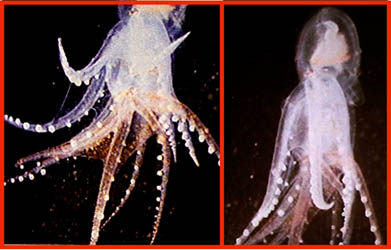
Figure. These pictures are from a video sequence taken from a submersible at about 900 m depth off Hawaii. A Vitreledonella drifted into view but clearly has too many arms. A closer look indicates that one octopus is within the web of another; presumably they are mating. Unfortunately, the hectocotylus cannot be identified. Photographs from Young, et al., 1999.
The females apparently brood their eggs within the mantle cavity until hatching since Joubin (1937) captured numerous hatchlings with a mature female.
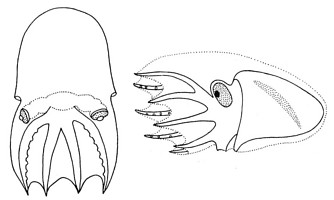
Figure. Hatchings of V. richardi, hatchlings. Left - Dorsal view 2.5 mm ML. Right - Side view, 2.2 mm ML. Drawings from Joubin, 1937, via Hochberg et al., 1992.
Behavior
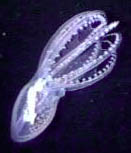
Figure. V. richardi,
side view. Frame grab from video.
Distribution
The best vertical distribution data is from the eastern North Atlantic. Until about 40 mm ML, most captures have been in the upper 300 m. The larger octopods have a very broad vertical distribution with most captures occuring in the upper mesopelagic zone but with some at lower mesopelagic depths during both the day and night. At night two captures were made in the lower regions of the epipelagic zone (Clarke and Lu, 1975 and Lu and Clarke, 1975).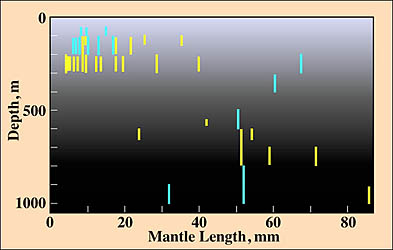
Figure. Vertical distribution of V. richardi. All captures were made with opening/closing trawls. Bars represent a capture and the bar length indicates the depth range of the trawl while open. Yellow bars indicate a daytime capture and blue bars a nighttime capture. Graph modified and redrawn from Clarke and Lu, 1975 and Lu and Clarke, 1975.
The geographical distribution of V. richardi is throughout the tropical and subtropical regions of the world's oceans (Nesis, 1982).
References
Clarke, M. R. and C. C. Lu. 1975. Vertical Distribution of cephalopods at 18 N 25 W in the North Atlantic. Journal of the Marine Biological Association of the United Kingdom, 55 (1): 165-182.
Hochberg, F. G., M. Nixon and R. B. Toll. 1992. Order Octopoda Leach, 1818. In: Sweeney, M. J., C. F. E. Roper, K. M. Mangold, M. R. Clarke and S. v. Boletzky (eds.) "Larval" and juvenile cephalopods: A manual for their identification. Smithson. Contr. Zool., 513:1-282.
Joubin, L. 1918. Etudes preliminaires sur les cephalopodes recueillis au cours des croisieres de S.A.S. le Prince de Monaco, 6e Note: Vitreledonella richardi Joubin. Bull. Inst. Oceanogr. Monaco 340: 1-40.
Joubin, L. 1937. Les octopodes de la croisiere du "Dana" 1921-22. Dana Report, 11: 1-49.
Lu, C. C. and M. R. Clarke, 1975. Vertical Distribution of cephalopods at 11 N 20 W in the North Atlantic. Journal of the Marine Biological Association of the United Kingdom, 55 (2): 369-389.
Nesis, K. N. 1982. Abridged key to the cephalopod mollusks of the world's ocean. 385+ii pp. Light and Food Industry Publishing House, Moscow. (In Russian.). Translated into English by B. S. Levitov, ed. by L. A. Burgess (1987), Cephalopods of the world. T. F. H. Publications, Neptune City, NJ, 351pp.
Roper, C. F. E., R. E. Young and G. L. Voss (1969). An illustrated key to the families of the order Teuthoidea. Smiths. contr. zool., 13:1-32.
Thore, S. 1949. Investigations on the "Dana" Octopoda. Dana-Report No. 33, 85pp.
Young, R. E., M. Vecchione and D. Donovan. 1999. The evolution of coleoid cephalopods and their present biodiversity and ecology. South African Jour. Mar. Sci..
Title Illustrations

| Scientific Name | Vitreledonella richardi |
|---|---|
| Location | Hawaiian waters |
| Specimen Condition | Live Specimen |
| Sex | Male |
| Life Cycle Stage | Immature |
| View | Side |
| Size | 90 mm ML |
| Image Use |
 This media file is licensed under the Creative Commons Attribution-NonCommercial License - Version 3.0. This media file is licensed under the Creative Commons Attribution-NonCommercial License - Version 3.0.
|
| Copyright |
© 1996

|
About This Page
Page copyright © 2018
 Page: Tree of Life
Vitreledonellinae . Vitreledonella richardi .
The TEXT of this page is licensed under the
Creative Commons Attribution-NonCommercial License - Version 3.0. Note that images and other media
featured on this page are each governed by their own license, and they may or may not be available
for reuse. Click on an image or a media link to access the media data window, which provides the
relevant licensing information. For the general terms and conditions of ToL material reuse and
redistribution, please see the Tree of Life Copyright
Policies.
Page: Tree of Life
Vitreledonellinae . Vitreledonella richardi .
The TEXT of this page is licensed under the
Creative Commons Attribution-NonCommercial License - Version 3.0. Note that images and other media
featured on this page are each governed by their own license, and they may or may not be available
for reuse. Click on an image or a media link to access the media data window, which provides the
relevant licensing information. For the general terms and conditions of ToL material reuse and
redistribution, please see the Tree of Life Copyright
Policies.
- First online 07 July 2013
- Content changed 16 November 2016
Citing this page:
Tree of Life Web Project. 2016. Vitreledonellinae . Vitreledonella richardi . Version 16 November 2016 (under construction). http://tolweb.org/Vitreledonella_richardi/149589/2016.11.16 in The Tree of Life Web Project, http://tolweb.org/


