


Heleophrynidae
Heleophryne
Ghost Frogs
- Heleophryne hewitti
- Heleophryne natalensis
- Heleophryne orientalis
- Heleophryne purcelli
- Heleophryne regis
- Heleophryne rosei
Introduction
These are known as the Ghost frogs. There is one genus, Heleophryne, with about six species. They are small to moderate sized frogs (30-65 mm). These frogs are found in rocky montane streams in South Africa; the tips of the fingers and toes are expanded. Synapomorphies of Heleophryne include the absence of keratinous beaks in larvae, although numerous rows of denticles are present.
The family Heleophrynidae is taxonomically redundant with the single genus Heleophryne. The name Heleophryne was defined by Ford and Cannatella (1993) to be the node-based name for the common ancestor of the living species of Heleophryne, and all its descendants. Synapomorphies of Heleophryne include the absence of keratinous beaks in larvae, although numerous rows of denticles are present. No fossils have been described.
Relationships to Outgroups
Most analyses of molecular data have placed Heleophryne as the sister-group of all other Neobatrachia.
Laurent (1979, 1986) included this taxon as a subfamily of Myobatrachidae, but there seem to be no derived characters that would suggest that relationship in preference to any other.
The phylogeny in Duellman and Trueb (1986) indicated that all neobatrachians excluding myobatrachids, sooglossids, and Heleophryne formed a subclade diagnosed by the evolutionary appearance of axillary amplexus (their character P). However, they pointed out that some "leptodactylids" have inguinal amplexus, suggesting that basal leptodactylids are paraphyletic, or that the character is reversed. In reporting inguinal amplexus in all three species of sooglossids, Nussbaum (1980) reviewed the literature on amplexus position; Somuncuria, a species of Batrachyla, and some Pleurodema have inguinal amplexus. The putative position of these taxa as basal leptodactylids (Lynch, 1978) suggested that inguinal amplexus may be primitive for these taxa as well.
A photo in Halliday and Adler (1986:38-39) shows Brachycephalus ephippium in inguinal amplexus. Other cases are known in Bufonidae: Osornophryne (Ruiz-C. and Hernández-C., 1976) and Bufo fastidiosus (Graybeal and de Queiroz, 1992). These are most likely derived reversals within the Neobatrachia.
Geographic Distribution

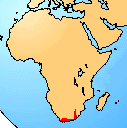
The distribution of living members of the family Heleophrynidae is indicated in red.
References
Duellman, W. E., and L. Trueb. 1986. Biology of Amphibians. McGraw-Hill Book Co., New York.
Ford, L. S., and D. C. Cannatella. 1993. The major clades of frogs. Herp. Monogr. 7:94-117.
Graybeal, A., and K. de Queiroz. 1992. Inguinal amplexus in Bufo fastidiosus, with comments on the systematics of bufonid frogs. J. Herpetol. 26:84-87.
Halliday, T. R., and K. Adler (Eds.). 1987. The Encyclopedia of Reptiles and Amphibians. Equinox, Oxford.
Laurent, R. F. 1979. Esquisse d'une phylogenèse des anoures. Bull. Soc. Zool. France 104:397-422.
Laurent, R. F. 1986. Sous classe des lissamphibiens. Systématique. Pp. 594-797 In P.-P. Grassé and M. Delsol (Eds.), Traité de Zoologie, Tome 14, 1B. Masson, Paris.
Lynch, J. D. 1978. A re-assessment of the telmatobiine leptodactylid frogs of Patagonia. Occ. Pap. Mus. Nat. Hist. Univ. Kansas (72):1-57.
Nussbaum, R. A. 1980. Phylogenetic implications of amplectant behavior in sooglossid frogs. Herpetologica 36:1-5.
Ruiz-C., P. M., and J. I. Hernández-C. 1976. Osornophryne, genero nuevo de anfibios bufonidos de Colombia y Ecuador. Caldasia 11:93-148.
About This Page
If you are interested in authoring or co-authoring the page for this taxon, or some part of it (even a species), contact David Cannatella.
Correspondence regarding this page should be directed to David Cannatella at
Page copyright © 1995
 Page: Tree of Life
Heleophrynidae. Heleophryne. Ghost Frogs.
The TEXT of this page is licensed under the
Creative Commons Attribution License - Version 3.0. Note that images and other media
featured on this page are each governed by their own license, and they may or may not be available
for reuse. Click on an image or a media link to access the media data window, which provides the
relevant licensing information. For the general terms and conditions of ToL material reuse and
redistribution, please see the Tree of Life Copyright
Policies.
Page: Tree of Life
Heleophrynidae. Heleophryne. Ghost Frogs.
The TEXT of this page is licensed under the
Creative Commons Attribution License - Version 3.0. Note that images and other media
featured on this page are each governed by their own license, and they may or may not be available
for reuse. Click on an image or a media link to access the media data window, which provides the
relevant licensing information. For the general terms and conditions of ToL material reuse and
redistribution, please see the Tree of Life Copyright
Policies.
- Content changed 20 December 2008
Citing this page:
Tree of Life Web Project. 2008. Heleophrynidae. Heleophryne. Ghost Frogs. Version 20 December 2008 (under construction). /Heleophryne/16942/2008.12.20 in The Tree of Life Web Project, /


