


Murinae
Scott J. Steppan
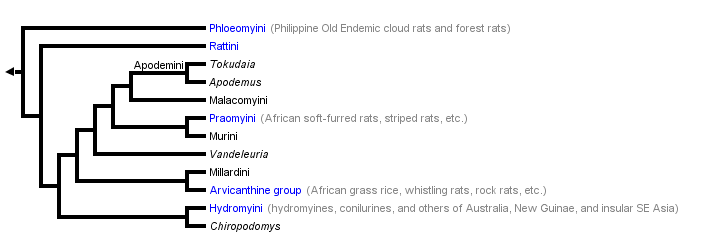


This tree diagram shows the relationships between several groups of organisms.
The root of the current tree connects the organisms featured in this tree to their containing group and the rest of the Tree of Life. The basal branching point in the tree represents the ancestor of the other groups in the tree. This ancestor diversified over time into several descendent subgroups, which are represented as internal nodes and terminal taxa to the right.
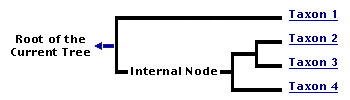
You can click on the root to travel down the Tree of Life all the way to the root of all Life, and you can click on the names of descendent subgroups to travel up the Tree of Life all the way to individual species.
For more information on ToL tree formatting, please see Interpreting the Tree or Classification. To learn more about phylogenetic trees, please visit our Phylogenetic Biology pages.
close boxIntroduction
The Old World Murinae contain well over 570 species and 125 genera. Phylogenetics for this group have been perhaps the most difficult to unravel of all major groups of mammals, to a large extent because of this high level of diversity that evolved over a relatively short time period. Many genera are not listed here for lack of sufficient information.
It should be noted that Mus and Rattus, containing the two most common laboratory species, do not represent two branches of the earliest split in Murinae. Their two lineages diverged several million years after the initial radiation and as part of a rapid diversification that may be associated with the expansion of murines from Southeast Asia into Africa, Australia, and Eurasia.
References
Carleton, M. D., Musser, G. G., 1984. Muroid rodents, in: Anderson, S. and Jones, J. K., Jr. (Eds.), Orders and Families of Recent Mammals of the World, John Wiley and Sons, New York, 289-379.
Ducroz, J. F., Volobouev, V., Granjon, L., 2001. An assessment of the systematics of arvicanthine rodents using mitochondrial DNA sequences: evolutionary and biogeographic implications. J. Mamm. Evol. 8, 173-206.
Hanni, C., Laudet, V., Barriel, V., Catzeflis, F. M., 1995. Evolutionary relationships of Acomys and other murids (Rodentia, Mammalia) based on complete 12S ribosomal-RNA mitochondrial gene-sequences. Isr. J. Zool. 41, 131-146.
Jacobs, L. L., Downs, W. R., 1994. The evolution of murine rodents in Asia, in: Tomida, Y., Li, C. K. and Setoguchi, T. (Eds.), Rodent and lagomorph families of Asian origins and diversification, National Science Museum Monographs, Tokyo, 149-156.
Jacobs, L. L., Flynn, L. J., Downs, W. R., Barry, J. C., 1990. "Quo vadis, Antemus?" The Siwalik muroid record, in: Lindsay, E. H., Fahlbusch, V. and Mein, P. (Eds.), European Neogene Mammal Chronology, Plenum Press, New York, 573-586.
Jansa, S. A., and M. Weksler. 2004. Phylogeny of muroid rodents: relationships within and among major lineages as determined by IRBP gene sequences. Mol. Phylogenet. Evol. 31:256-276.
Lecompte, E., Aplin, K., Denys, C., Catzeflis, F., Chades, M., and Chevret, P. 2008. Phylogeny and biogeography of African Murinae based on mitochondrial and nuclear gene sequences, with a new tribal classification of the subfamily. BMC Evol. Biol. 8:199.
LeCompte, E., Granjon, L., Denys, C., 2002a. The phylogeny of the Praomys complex (Rodentia: Muridae) and its phylogeographic implications. J. Zool. Syst. Evol. Res. 40, 8-25.
LeCompte, E., Granjon, L., Kerbis-Peterhans, J., Denys, C., 2002b. Cytochrome b-based phylogeny of the Praomys group (Rodentia, Murinae): a new African radiation? C. R. Biol. 325, 827-840.
Misonne, X., 1969. African and Indo-Australian Muridae, evolutionary trends. Mus. R. Afrique Cent., Tervuren, Zool. 172, 1-219.
Musser, G. M., Carleton, M. D., 1993. Family Muridae, in: Wilson, D. E. and Reeder, D. M. (Eds.), Mammal species of the world: a taxonomic and geographic reference, Smithsonian Institution, Washington, 501-756.
Musser, G.M. and M.D. Carleton. 2005. Superfamily Muroidea. In: Wilson, D.E. and D.M. Reeder (Eds.), Mammal Species of the World: a Taxonomic and Geographic Reference, third ed. The Johns Hopkins University Press, Baltimore, pp. 894-1531.
Musser, G. G., Heaney, L. R., 1992. Philippine rodents: definitions of Tarsomys and Limnomys plus a preliminary assessment of phylogenetic patterns among native Philippine murines (Murinae, Muridae). Bull. Amer. Mus. Nat. Hist. 211, 2-138.
Rowe, K., Reno, M. L., Richmond, D. M., Adkins, R. M., and Steppan, S. J. 2008. Pliocene colonization and adaptive radiations in Australia and New Guinea (Sahul): Multi-locus systematics of the Old Endemic rodents (Muroidea: Murinae). Mol. Phylogenet. Evol. 47:84-101.
Senegas, F., Avery, D. M., 1998. New evidence for the murine origins of the Otomyinae (Mammalia, Rodentia) and the age of Bolt's Farm (South Africa). S. Afr. J. Sci. 94, 503-507.
Steppan, S. J., R. M. Adkins, and J. Anderson. 2004. Phylogeny and divergence-date estimates of rapid radiations in muroid rodents based on multiple nuclear genes. Syst. Biol. 53:533-553
Steppan, S. J., Adkins, R. M., Spinks, P. Q., and Hale, C. 2005. Multigene phylogeny of the Old World mice Murinae reveals distinct geographic lineages and the declining utility of mitochondrial genes compared to nuclear genes. Mol. Phylogenet. Evol. 37:370-388.
Watts, C. H. S., Baverstock, P. R., 1995. Evolution in the Murinae (Rodentia) assessed by microcomplement fixation of albumin. Aust. J. Zool. 43, 105-118.
Title Illustrations

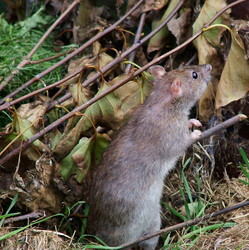
| Scientific Name | Rattus norvegicus |
|---|---|
| Specimen Condition | Live Specimen |
| Source | Wild Rat |
| Source Collection | Flickr |
| Image Use |
 This media file is licensed under the Creative Commons Attribution License - Version 2.0. This media file is licensed under the Creative Commons Attribution License - Version 2.0.
|
| Copyright | © 2007 Reg Mckenna |

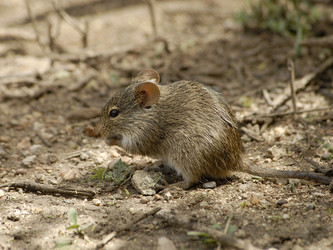
| Scientific Name | Lemniscomys griselda |
|---|---|
| Location | Serengeti National Park, Tanzania |
| Specimen Condition | Live Specimen |
| Source | D5_single-striped_mouse_0476 |
| Source Collection | Flickr |
| Image Use |
This media file is licensed under the Creative Commons Attribution-NonCommercial-NoDerivs License - Version 2.0.
|
| Copyright | © 2008 Mike LaBarbera |

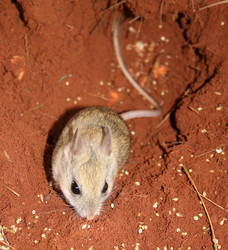
| Scientific Name | Notomys alexis |
|---|---|
| Location | Warratah Park Animal Sanctuary, Sydney, New South Wales, Australia |
| Specimen Condition | Live Specimen |
| Source | Spinifex Hopping Mouse |
| Source Collection | Flickr |
| Image Use |
This media file is licensed under the Creative Commons Attribution-NonCommercial License - Version 2.0.
|
| Copyright | © 2006 Brian Yap (葉) |
About This Page
Scott J. Steppan

Florida State University, Tallahassee, Florida, USA
Correspondence regarding this page should be directed to Scott J. Steppan at
Page copyright © 2005 Scott J. Steppan
All Rights Reserved.
- Content changed 08 September 2008
Citing this page:
Steppan, Scott J. 2008. Murinae. Version 08 September 2008 (under construction). http://tolweb.org/Murinae/16536/2008.09.08 in The Tree of Life Web Project, http://tolweb.org/

