


Stramenopiles
J. Craig Bailey

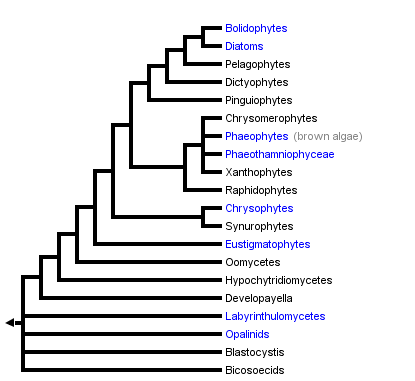


This tree diagram shows the relationships between several groups of organisms.
The root of the current tree connects the organisms featured in this tree to their containing group and the rest of the Tree of Life. The basal branching point in the tree represents the ancestor of the other groups in the tree. This ancestor diversified over time into several descendent subgroups, which are represented as internal nodes and terminal taxa to the right.
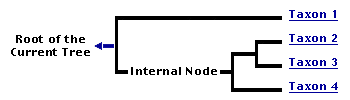
You can click on the root to travel down the Tree of Life all the way to the root of all Life, and you can click on the names of descendent subgroups to travel up the Tree of Life all the way to individual species.
For more information on ToL tree formatting, please see Interpreting the Tree or Classification. To learn more about phylogenetic trees, please visit our Phylogenetic Biology pages.
close boxReferences
Leipe, D.D., Wainright, P.O., Gunderson, J.H., Porter, D., Patterson, D.J.,Valois, F., Himmerich, S. and Sogin, M.L. (1994): The stramenopiles from a molecular perspective: 16S-like rRNA sequences from Labyrinthuloides minuta and Cafeteria roenbergensis. Phycologia. 33:369-377.
Patterson, D.J. (1989): Stramenopiles: chromophytes from a protistan perspective. In: Green J.C., Leadbeater B.S.C. and diver W.L. (eds): The chromophyte algae problems and perspectives, pp. 357-379. Clarendon Press, Oxford.
Title Illustrations

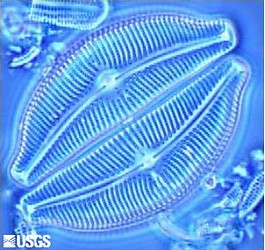
| Scientific Name | Cymbella tumida |
|---|---|
| Acknowledgements | Photograph courtesy of the U.S. Geological Survey |

| Scientific Name | Macrocystis integrifolia |
|---|---|
| Location | California, USA |
| Specimen Condition | Live Specimen |
| Source | Macrocystis integrifolia |
| Source Collection | Flickr |
| Image Use |
 This media file is licensed under the Creative Commons Attribution License - Version 2.0. This media file is licensed under the Creative Commons Attribution License - Version 2.0.
|
| Copyright | © 2006 Ed Bierman |

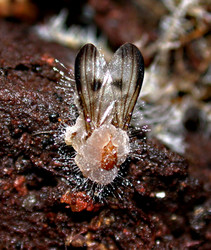
| Scientific Name | Saprolegnia sp. |
|---|---|
| Location | Cape Arago State Park, Coos County, Oregon, USA |
| Comments | Not actually a fungus, but a stramenopile, a weirdo stem eukaryote. |
| Specimen Condition | Live Specimen |
| Source | Fly fungus (Saprolegnia) |
| Source Collection | Flickr |
| Image Use |
This media file is licensed under the Creative Commons Attribution-NonCommercial-ShareAlike License - Version 2.0.
|
| Copyright | © 2005 Steve Lew |
About This Page
This page is being developed as part of the Tree of Life Web Project Protist Diversity Workshop, co-sponsored by the Canadian Institute for Advanced Research (CIFAR) program in Integrated Microbial Biodiversity and the Tula Foundation.
J. Craig Bailey

University of North Carolina Wilmington, Wilmington, North Carolina, USA
Correspondence regarding this page should be directed to J. Craig Bailey at
Page copyright © 2010 J. Craig Bailey
All Rights Reserved.
- Content changed 28 April 2010
Citing this page:
Bailey, J. Craig. 2010. Stramenopiles. Version 28 April 2010 (under construction). http://tolweb.org/Stramenopiles/2380/2010.04.28 in The Tree of Life Web Project, http://tolweb.org/

